
Have you ever come across the density symbol in a science formula and felt unsure about what it means? Many students find symbols confusing when they first learn about density, mass, and volume. Understanding these symbols can make chemistry and physics formulas much easier to follow. Once you know what each symbol represents, solving related problems becomes simpler.
The density symbol is an important part of scientific notation and is commonly used to represent density in chemistry and physics. It helps describe how much mass is contained within a specific volume of a substance. In this guide, you will learn the symbol for density, its meaning, and how it is used in chemistry formulas.
Meaning of the Density Symbol
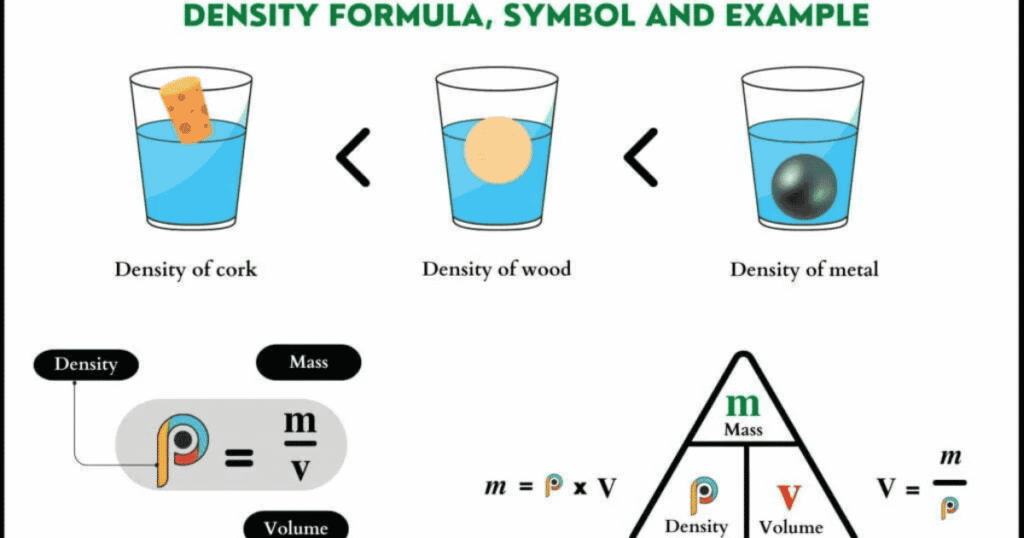
The Density Symbol shows how much mass is contained within a specific volume of matter. Scientists commonly represent it with the Greek letter rho, ρ. You’ll see this symbol often in physics and chemistry. It helps explain how closely the particles of a material are packed together and makes scientific calculations easier to understand.
In simple terms, density compares mass with volume. The formula is ρ = m/V, where m means mass and V means volume. For example, a piece of metal can have high density because it contains a lot of mass in a small space. Water has lower density than many common metals.
Standard Units Used With Density
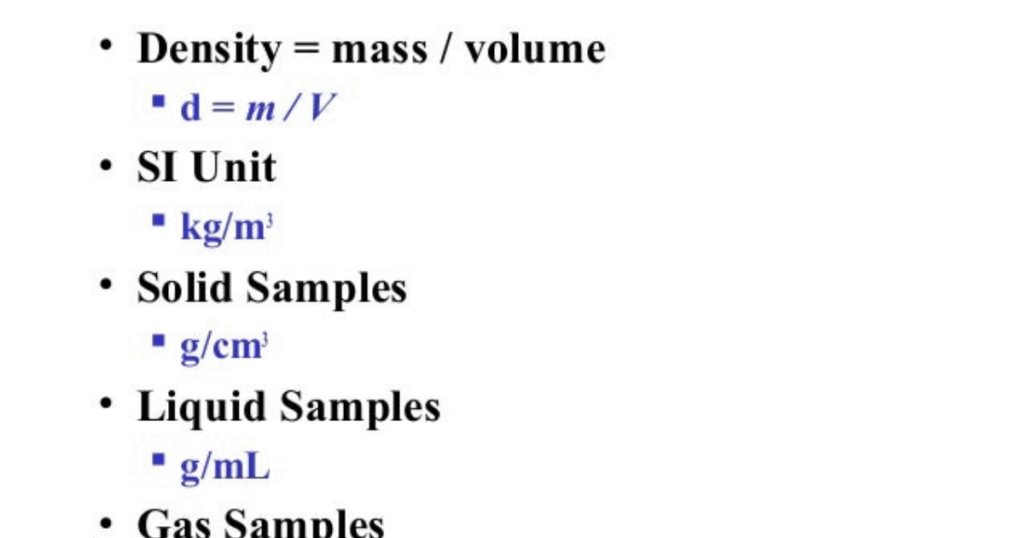
Density is measured using standard units based on mass and volume. The SI unit is kilograms per cubic meter, written as kg/m³. Smaller measurements often use grams per cubic centimeter, g/cm³, or grams per milliliter, g/mL. These units help scientists report density clearly and compare materials in physics, chemistry, engineering, and other scientific fields with accurate and consistent scientific results.
Different materials may use different density units depending on their size and application. For example, water has a density of about 1 g/mL. When working with SI calculations, kg/m³ is preferred. You can convert between units when needed, but always check that mass and volume use compatible units before calculating or comparing density values for accurate scientific calculations and comparisons.
- kg/m³: Standard SI unit of density.
- g/cm³: Commonly used for solid materials.
- g/mL: Often used for liquids.
- kg/L: Useful for some liquid measurements.
- 1 g/cm³: Equal to 1 g/mL.
- Water: About 1 g/mL at common reference conditions.
- Unit conversion: Helps compare density values correctly.
- Mass unit: Usually grams or kilograms.
- Volume unit: Usually cubic centimeters, milliliters, or cubic meters.
- Important rule: Keep mass and volume units compatible.
Why the Density Symbol Matters in Science
The density matters because one small Greek letter can describe a major property of matter. The symbol ρ, called rho, tells scientists how much mass fits into a given volume. This simple relationship helps explain why objects float or sink, why materials behave differently, and how scientists compare substances accurately during experiments, calculations, and practical scientific work.
Density Symbol in Physics
In physics, the density ρ helps connect mass, volume, and the behavior of matter. It appears in formulas involving pressure, buoyancy, fluids, and motion. For example, water pushes against objects differently from air because their densities differ greatly. Physicists use density values to predict floating, sinking, fluid behavior, and how forces act within different materials and environments around us.
Density Symbol in Chemistry
Chemists use ρ to identify and compare substances because density can provide useful clues about composition. A liquid’s density may help distinguish it from another liquid or reveal changes caused by temperature or dissolved substances. Density also supports calculations involving solutions, gases, and solids. In laboratory work, accurate density measurements can help check whether a material matches its expected properties.
Density Symbol in Engineering
Engineers rely on the density when choosing materials and designing safe structures. Density affects weight, strength-to-weight decisions, fuel storage, fluid movement, and transportation systems. For example, engineers may compare aluminum with steel when designing a vehicle part. Knowing density helps them estimate total mass, energy needs, load limits, and how efficiently a design may perform under real operating conditions.
Density Symbol in Mathematics
Mathematics gives density a clear structure by expressing it as mass divided by volume. The symbol ρ makes this relationship compact and easy to use in equations. Once two values are known, you can rearrange the formula to find the third. This mathematical approach also helps students understand ratios, unit conversions, proportional reasoning, and real-world measurement problems more confidently today.
Read More : Does Not Equal Sign: Meaning, Symbol, Uses & How to Type It
Real-Life Uses of Density
Density helps us understand why materials behave differently in daily life. It guides choices in cooking, transportation, construction, medicine, and many other practical activities around us.
- Cooking: Density helps compare ingredients and understand how liquids and foods behave.
- Swimming: Density explains why some people float more easily than others.
- Transportation: Engineers use density to reduce vehicle weight and improve fuel efficiency.
- Construction: Material density helps engineers choose suitable building materials.
- Oil and water: Their different densities cause them to form separate layers.
- Medicine: Density measurements can help study bones, tissues, and body materials.
- Industry: Factories use density to identify materials and check product quality.
Density Symbol and Floating Objects
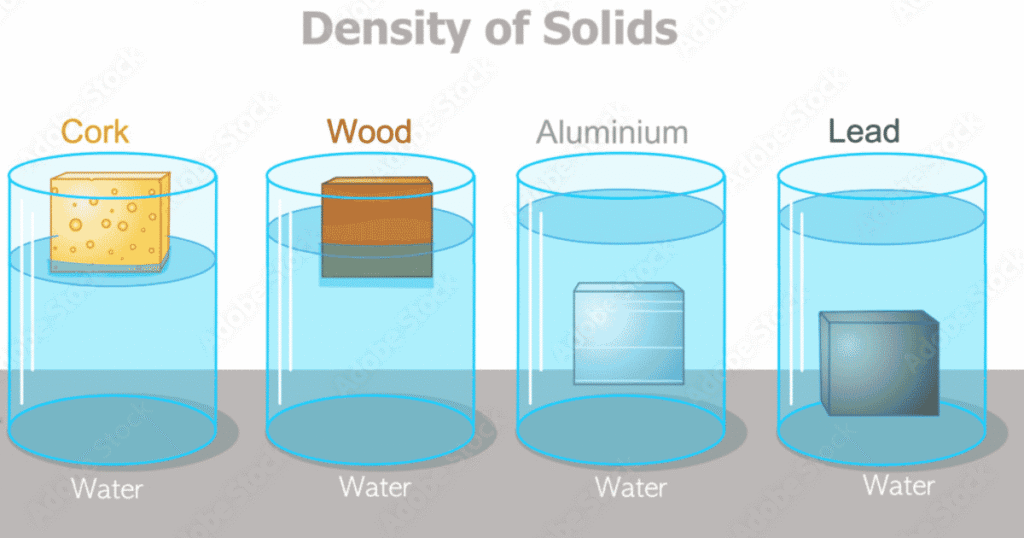
The density, ρ, helps explain why some objects float while others sink. An object usually floats when its average density is lower than the surrounding liquid. For example, wood floats on water because its density is lower. A metal coin sinks because its density is higher. This simple comparison helps explain buoyancy in everyday situations and scientific experiments.
The density of both the object and liquid affects floating behavior. When an object has the same average density as water, it can remain suspended instead of rising or sinking. Ships are a useful example because their hollow shape lowers their overall density. This allows heavy materials to float when enough water is displaced by the ship’s large volume.
Density Symbol in Astronomy
Astronomers use the density ρ to study stars, planets, moons, and other space objects. Density helps them understand what these objects contain and how tightly their matter is packed. For example, Earth has a much higher average density than Saturn. By comparing density values, scientists can learn about planetary composition, internal structure, and formation.
Density also helps astronomers study extreme objects such as white dwarfs and neutron stars. These objects contain enormous amounts of mass in surprisingly small spaces. A neutron star has an incredibly high density compared with ordinary materials. Astronomers use density measurements alongside mass and size to understand how gravity, pressure, temperature, and matter behave in extreme cosmic environments.
Density Symbol in Fluid Mechanics
The density ρ is important in fluid mechanics because fluids behave differently based on their density. Engineers use density to study water, oil, air, and other fluids. It affects pressure, buoyancy, flow, and energy movement. For example, denser liquids generally create greater pressure at the same depth, which matters when designing tanks, pipes, dams, and large pumps safely.
In fluid systems, density can change with temperature, pressure, or composition. These changes can affect how a fluid moves through pipes or around objects. Engineers use density values in calculations to predict flow behavior and system performance. Understanding ρ also helps explain why warm air rises, why oil floats on water, and how ships remain supported by water naturally.
- Fluid pressure: Density affects pressure within liquids.
- Water systems: It helps engineers design pipes, tanks, and dams.
- Buoyancy: Density helps explain why objects float or sink.
- Air movement: Differences in air density influence rising and sinking air.
- Oil and water: Their different densities cause separation.
- Flow calculations: Density is used to predict fluid movement.
- Engineering design: Density supports safer and more efficient fluid systems.
Read More : Acura Symbol: Meaning, History, Design, Colors & Logo Evolution
Difference Between Mass and Density
Mass and density describe different properties of matter. Mass tells you how much matter an object contains, while density shows how closely that matter is packed within a given volume.
| Mass | Density |
| Measures the amount of matter in an object. | Measures how much mass exists in a specific volume. |
| Usually measured in kilograms or grams. | Commonly measured in kg/m³ or g/cm³. |
| Mass is represented by m. | Density is represented by ρ. |
| Mass does not depend on an object’s size alone. | Density depends on mass and volume. |
| A larger object can have greater mass. | A smaller object can have greater density. |
| Mass is found using a balance or scale. | Density can be calculated from mass and volume. |
| Mass stays constant when location changes. | Density can change when temperature or pressure changes. |
| Two objects can have the same mass. | Their densities can still be different. |
| Mass helps determine the amount of matter. | Density helps identify and compare materials. |
| Mass is used in many physical calculations. | Density is important for buoyancy, fluids, and material studies. |
Materials With High and Low Density
Materials with high density contain more mass within a small volume. Metals such as iron, copper, and lead are common examples. They often feel heavy for their size. High-density materials are useful in construction, machinery, and manufacturing. Their density helps engineers choose materials that can handle weight, pressure, and other demanding conditions during practical applications.
Low-density materials contain less mass in the same volume. Wood, foam, plastic, and some gases are common examples. They often feel lighter and can be useful when reducing weight matters. Low-density materials are used in packaging, insulation, aircraft parts, and floating products. Their properties make them valuable where lightweight designs and easy handling are important.
- Iron: A dense metal used in buildings and machinery.
- Copper: Dense and widely used in electrical applications.
- Lead: Very high density compared with many common metals.
- Wood: Generally has lower density and can float on water.
- Foam: Extremely lightweight because it contains lots of air.
- Plastic: Density varies depending on its type and structure.
- Aluminum: Relatively low density compared with steel.
- Air: Has very low density compared with liquids and solids.
Density Symbol in Medical Science

The density ρ has useful applications in medical science. Doctors and researchers can study the density of bones, tissues, fluids, and other body materials. Bone density is especially important because it can show changes in bone strength. Medical imaging methods can also use differences in tissue density to help identify unusual areas within the body.
Density measurements can also support research involving blood, organs, and biological tissues. Different tissues have different densities, which helps scientists distinguish them during imaging and laboratory studies. For example, changes in bone density may indicate weakening over time. Understanding these differences supports medical research, diagnosis, treatment planning, and the development of better healthcare technologies for patients.
Common Mistakes While Using Density Symbols
Small errors with density can change your answer. Always check the formula, units, mass, volume, and temperature before calculating density or comparing different materials.
- Confusing symbols: Don’t confuse ρ with mass or volume symbols.
- Wrong formula: Use density as mass divided by volume.
- Incorrect units: Make sure mass and volume units are compatible.
- Skipping conversions: Convert measurements before starting calculations.
- Ignoring temperature: Remember that temperature can affect density.
- Reading ρ incorrectly: The symbol ρ is called rho.
- Rounding too early: Keep accurate values until the final answer.
Easy Method to Calculate Density
Calculating density is easier than it may seem. First, find the object’s mass using a suitable scale. Then measure its volume using the correct method. Finally, divide the mass by the volume to get density. The formula is ρ = m/V. Always check that your mass and volume units match before completing the calculation for an accurate result.
For example, suppose an object has a mass of 200 grams and a volume of 50 cubic centimeters. Divide 200 by 50 to get 4 g/cm³. This means each cubic centimeter contains 4 grams of mass. If the object’s shape is irregular, you can find its volume using water displacement before applying the same density formula for calculation.
Density Symbol in Computer Simulations
Computer simulations use the density ρ to represent how much mass is packed into a certain volume. Scientists and engineers can enter density values into software to model fluids, materials, and physical systems. These simulations help predict how objects move, how liquids flow, and how materials respond under different conditions without needing to test every situation in real life.
Density simulations are useful when real experiments are expensive, difficult, or unsafe. For example, engineers can model air density around an aircraft or water flow through a pipe. Changing the density value lets them study different conditions and compare results. This saves time, reduces costs, and helps researchers improve designs before building or testing physical models in practice in detail.
History of Density Studies
The study of density has a long history in science. Ancient Greek thinker Archimedes helped establish important ideas about density and buoyancy while investigating whether a crown was made of pure gold. His work showed that comparing mass and volume could reveal useful information about materials and objects. These ideas later became important parts of physics and scientific measurement.
Over time, scientists developed better methods for measuring mass and volume accurately. The concept of density became widely used in physics, chemistry, engineering, and material science. Today, the Greek letter rho, ρ, commonly represents density in scientific formulas. Modern instruments and computer simulations now make density measurements faster, more precise, and useful across many fields.
Instruments Used to Measure Density
Different instruments help scientists measure density accurately. The right tool depends on whether the sample is a solid, liquid, or gas and how precise the measurement needs to be.
- Hydrometer: Measures the density or specific gravity of liquids.
- Density meter: Provides quick and accurate liquid density measurements.
- Pycnometer: Measures liquid density using a precisely known volume.
- Digital density meter: Uses electronic sensors for fast results.
- Balance: Measures mass before density is calculated.
- Graduated cylinder: Helps measure liquid volume accurately.
- Water displacement setup: Finds the volume of irregular solid objects.
Frequently Asked Questions
Here are 10 optimized FAQs with concise answers, natural keyword use, and 25–28 words each.
Is density rho or p?
Density is represented by rho, written as ρ, not p. The Density ρ is the standard notation used in physics, chemistry, and science.
What is the symbol for density?
The symbol for density is ρ, called rho. The Density Symbol represents mass per unit volume and appears commonly in scientific formulas and calculations.
How to write θ?
The symbol θ is the Greek letter theta, not the Density. Density uses ρ, while theta often represents angles in mathematics and physics.
What is the symbol and unit for density?
The Density is ρ, while its SI unit is kilograms per cubic meter, written as kg/m³. Other units include g/cm³ and g/mL.
Is density called rho?
Yes, density is commonly represented by the Greek letter rho, ρ. The Density Symbol rho is widely used in physics, chemistry, and engineering calculations.
What is rho × g × h?
Rho × g × h represents pressure caused by a fluid column. Here, ρ is the Density, g means gravity, and h represents height.
Is density an SI unit?
No, density isn’t an SI unit. Density is a physical quantity, while kg/m³ is its SI unit. The Density Symbol is ρ.
What is a formula for density?
The density formula is ρ = m/V, where ρ is the Density Symbol, m represents mass, and V represents volume of the material.
What is density called?
Density describes how much mass exists within a specific volume. Its Density Symbol is ρ, also called rho in scientific notation and formulas.
How to calculate a density?
To calculate density, divide mass by volume using ρ = m/V. The Density ρ represents the result, usually expressed in kg/m³.
Conclusion
The Density Symbol is a simple but important part of science. It is written as ρ and is called rho. It shows the relationship between mass and volume. This symbol helps explain why some materials are heavy while others are light. You can use it in physics, chemistry, engineering, mathematics, and medical science.
Understanding ρ also helps explain everyday examples. It shows why wood floats while metal sinks. The symbol for density in chemistry is ρ. The Density Symbol works with units such as kg/m³ and g/cm³. Learning this notation makes calculations easier. Once you understand ρ, you can apply it confidently to scientific problems and practical situations involving different materials, liquids, and gases.