

Have you ever seen the Plus Minus symbol and wondered what it means or how to type it? This simple sign appears in mathematics, science, measurements, and everyday information. It can show that a value may be slightly higher or lower than a stated number. If you’ve searched for this symbol on your keyboard, you’re certainly not alone.
This guide explains the Plus Minus symbol in simple terms. You’ll learn its meaning, history, common uses, and practical examples. We’ll also cover easy ways to type it on Windows, Mac, Word, Excel, and HTML. Related terms such as the plus minus sign and +- symbol will also be explained clearly for quick understanding.
History of the Plus Minus Symbol

The history of the plus-minus symbol reflects the growing need for clear mathematical notation. Earlier writers often used words or separate symbols to describe positive and negative possibilities. As mathematical notation developed, a combined sign became more convenient. The symbol eventually offered a simple way to present two related values without writing the same equation twice.
During the development of algebra, mathematicians increasingly used compact symbols to express complex ideas. The plus-minus sign became especially useful when an equation produced two possible answers. Instead of repeating calculations, writers could place both options beside one result. This made equations easier to read, compare, and solve.
Today, the symbol remains common in mathematics, science, statistics, engineering, and everyday measurements. It can show uncertainty, tolerance, variation, or two possible results. You may see it in laboratory data, product specifications, and temperature reports. Its simple shape saves space while giving readers important information about possible numerical values in a clear format.
Common Uses of the Plus Minus Symbol
The Plus Minus is small, but it does a lot of work. You’ll see it whenever a number can vary, represent two possibilities, or include a measured amount of uncertainty. Its meaning changes slightly with context, yet the basic idea stays simple: it connects a value with its positive and negative possibilities.
Mathematics
In mathematics, the plus or minus symbol often shows two possible answers. For example, solving x² = 25 gives x = ±5. This means both 5 and -5 are valid solutions. It also appears in formulas and algebraic equations. Using one symbol saves space and makes mathematical notation easier to understand without repeating the same calculation twice.
Science
Scientists use the symbol when measurements include uncertainty or variation. For example, a temperature might be recorded as 25°C ± 0.5°C. This means the actual value may fall slightly above or below 25°C. Laboratory reports often use this notation to show measurement limits. It helps readers understand that scientific measurements aren’t always perfectly exact.
Engineering
Engineers use plus-minus notation to describe acceptable limits and manufacturing tolerance. A part listed as 50 mm ± 0.2 mm can measure between 49.8 and 50.2 mm. This small range matters when components must fit together correctly. Technical drawings, construction plans, and machine specifications often rely on this notation to communicate precise dimensional requirements clearly.
Statistics
In statistics, the symbol can describe variation around an estimated value. For instance, a survey result might report 60% ± 3%. This suggests a range around the reported percentage rather than one perfectly fixed number. You may also see it with standard deviation, measurement uncertainty, or margin of error. Context determines exactly how readers should interpret the range.
Electronics
Electronic components often include tolerance values marked with the symbol. A resistor rated at 100 ohms ± 5% may have a real resistance between 95 and 105 ohms. Manufacturers use this notation to show expected component variation. It helps technicians and engineers choose suitable parts and understand how small differences can affect circuit performance.
Popular Uses of the Plus Minus Symbol
The plus or minus symbol appears in many fields where values can change or include a specific range. Its meaning depends on whether you’re working with mathematics, science, measurements, or technical data.
It often communicates possible values, uncertainty, tolerance, or variation in a compact form. The interpretation may vary depending on the situation:
| Area | Common Use | Example | Meaning |
| Mathematics | Shows two possible solutions | x = ±5 | x can be 5 or -5 |
| Science | Shows measurement uncertainty | 25°C ± 0.5°C | The value may vary by 0.5°C |
| Engineering | Shows dimensional tolerance | 50 mm ± 0.2 mm | The acceptable range is 49.8–50.2 mm |
| Statistics | Shows variation or margin of error | 60% ± 3% | The reported result has a stated range |
| Electronics | Shows component tolerance | 100 Ω ± 5% | Resistance may vary within the stated tolerance |
| Medicine | Reports measured variation | 120 ± 5 mmHg | The measurement may vary around the reported value |
| Weather | Indicates temperature variation | 20°C ± 2°C | Temperatures may range around 20°C |
This table shows why the symbol remains useful. It gives readers a quick way to understand numerical range, uncertainty, and acceptable variation.
Read More : Legalism Symbol: Meaning, History, Elements, Philosophy & Modern Uses
Plus Minus Symbol on Different Devices
Finding the Plus Minus symbol can be frustrating when it isn’t printed on your keyboard. Luckily, you don’t need special software to type it. Windows, Microsoft Word, Mac, HTML, and Excel all provide convenient options. Some methods use keyboard shortcuts while others rely on character codes. Once you know the right method, inserting ± becomes quick and simple.
Windows Alt Code
Windows users can type the plus-minus sign with Alt + 0177. First, turn on Num Lock and place the cursor where you want the symbol. Hold the Alt key and enter 0177 using the numeric keypad. Release Alt afterward. The ± character should appear. If your keyboard lacks a number pad, Character Map provides another useful option.
Microsoft Word
Microsoft Word offers several simple ways to insert the plus or minus symbol. One quick method uses Unicode. Type 00B1, then press Alt + X to change the code into ±. You can also select Insert, choose Symbol, and find the character manually. This option is helpful when creating reports, assignments, equations, or technical documents.
Mac Keyboard
Mac users can type the ± symbol with a convenient keyboard shortcut. Press Option + Shift + = together, and the character should appear where your cursor sits. This method works in many common applications. It saves time when you’re writing measurements, equations, or scientific notes. You won’t need to search through menus whenever you need this useful symbol.
HTML Code
When creating webpages, you can insert the plus-minus symbol with HTML character codes. Two common options are ± and ±, both of which display ±. The symbol also has the Unicode value U+00B1. These methods are useful for web developers because they provide reliable ways to display mathematical notation correctly across webpages and browsers.
Excel
Excel lets you insert ± as text in several easy ways. You can copy and paste the character directly into a cell or use the Windows Alt code. However, Excel doesn’t treat ± as a standard calculation operator. For calculations requiring two results, create separate formulas. This approach keeps your spreadsheet accurate while still displaying the desired plus-minus notation.
Plus Minus Symbol Shortcuts
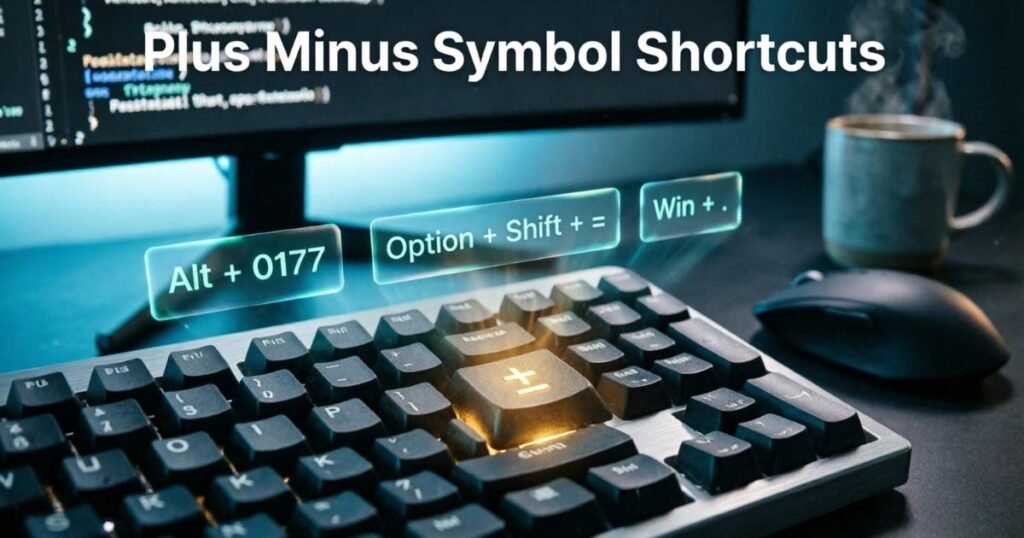
The right shortcut can save time when you need the ± character repeatedly. Different platforms use different methods, including keyboard shortcuts, Alt codes, Unicode, and HTML codes.
The interpretation may vary depending on the device or application:
| Platform or Method | Shortcut / Code | Result | Best Use |
| Windows | Alt + 0177 | ± | Quick keyboard entry |
| Microsoft Word | 00B1 + Alt + X | ± | Documents and assignments |
| Mac | Option + Shift + = | ± | macOS applications |
| HTML | ± | ± | Websites and webpages |
| HTML Numeric | ± | ± | Web coding |
| Unicode | U+00B1 | ± | Digital text and applications |
| Copy and Paste | ± | ± | Quick entry on any device |
These shortcuts make the plus minus sign easier to use across different platforms. If one method doesn’t work on your device, copy and paste ± as a simple alternative.
Difference Between Plus Minus and Minus Plus Symbols
The Plus Minus symbol and the minus-plus symbol look similar, but they don’t always mean the same thing. Their order matters, especially in mathematical equations where paired signs represent related solutions. Understanding the difference helps you read formulas correctly and avoid confusing two separate mathematical ideas.
Plus Minus (±)
The ± symbol means plus or minus. It usually shows two possible values or solutions. For example, x = ±5 means x can equal 5 or -5. In measurements, it can also show uncertainty or tolerance. You’ll often see it in mathematics, science, engineering, and statistics when a value can vary above or below a stated number.
Minus Plus (∓)
The ∓ symbol means minus or plus. It often appears alongside ± when two connected equations or solutions must use opposite signs. For example, ±a ∓b means that when the first sign is positive, the second is negative. This paired notation keeps related mathematical expressions organized and shows which signs should be used together.
Advantages of Using the Plus Minus Symbol
The plus-minus symbol makes numerical information shorter and clearer. It helps you show possible values, uncertainty, tolerance, and variation without writing lengthy explanations.
- Saves space: Combines two related values in one compact symbol.
- Improves clarity: Makes ranges and possible results easier to understand.
- Shows uncertainty: Clearly represents measurement uncertainty in scientific data.
- Useful in mathematics: Helps present two possible solutions quickly.
- Supports engineering: Shows acceptable manufacturing and component tolerances.
- Helps statistics: Communicates variation, margins of error, and estimates.
- Works across fields: Appears in science, medicine, electronics, construction, and technical writing.
Examples of Plus Minus Symbol in Daily Life
The plus-minus sign isn’t limited to textbooks and equations. You may see it in everyday information without noticing. It helps people show an estimated value, acceptable range, measurement uncertainty, or expected variation in a simple way.
Weather Reports
Weather reports often use ± when temperatures or measurements may vary slightly. For example, a forecast might mention a temperature of 25°C ± 2°C. This suggests the actual temperature could be somewhat higher or lower. Such notation helps readers understand that weather predictions aren’t always exact. It gives a practical numerical range without adding lengthy explanations.
Product Specifications
Product labels and technical specifications often use the plus-minus symbol to show acceptable variation. For example, a component may have a thickness of 10 mm ± 0.2 mm. This means the actual measurement can fall slightly above or below the stated value. Manufacturers use this notation to communicate tolerance clearly and maintain consistent product standards.
Medical Research
Medical researchers use the plus-minus symbol when reporting measurements, averages, or statistical results. For example, a study might report an average age as 40 ± 5 years. The number following ± can describe variation around the average. This notation helps readers understand that research results represent groups of people rather than one exact measurement.
Construction Projects
Construction projects rely on accurate measurements, but small variations can sometimes be acceptable. A drawing may specify a length of 50 mm ± 1 mm. This means the finished measurement can vary within the stated tolerance. Engineers and builders use this notation to communicate requirements clearly. It helps prevent confusion during planning, manufacturing, and installation.
Overall, the plus-minus symbol provides a quick way to communicate variation in real-world situations. Whether you’re reading a forecast, product label, research paper, or construction plan, it makes numerical information easier to interpret.
Read More : Vendavel Meaning: Origin, Pronunciation, Symbolism, Name & Uses
Mathematical Examples
Mathematics becomes easier when you can see how a symbol works in real equations. The plus-minus sign is especially useful because it can represent two possible values. Here are three simple examples that show how Plus Minus symbol notation works in everyday mathematical problems.
Example 1
Consider the equation x² = 16. Taking the square root gives x = ±4 because both 4 × 4 and -4 × -4 equal 16. The plus-minus sign saves you from writing two separate answers. In this case, the equation has two solutions. It clearly shows that x can have either a positive or negative value.
Example 2
Suppose a measurement is written as 20 ± 2 cm. This notation gives a range rather than one exact measurement. The value can be as low as 18 cm or as high as 22 cm. You can think of the ± sign as a small window around the central value. It helps communicate acceptable variation quickly and clearly.
Example 3
Imagine a calculation gives the answer x = 7 ± 3. The two possible values are 10 and 4. Here, the plus-minus notation shows that three is added or subtracted from seven. This simple example demonstrates how the symbol represents two numerical possibilities. It also makes mathematical expressions shorter without losing important information for the reader.
Together, these examples show why plus-minus notation remains useful. It can represent solutions, ranges, and variations in just one compact form.
Unicode and Character Information

The ± symbol has a standard Unicode identity that makes it easy to use across digital platforms. Character information is useful when you need to copy, code, search, or display the symbol correctly.
Unicode gives the character a unique code point. This helps computers and applications recognize the plus-minus character consistently, whether you’re working with text, webpages, documents, or software.
The interpretation may vary depending on the situation:
| Character Information | Value | What It Means |
| Symbol | ± | Standard plus-minus character |
| Unicode | U+00B1 | Official Unicode code point |
| Decimal Code | 177 | Decimal character value |
| HTML Entity | ± | Named HTML entity for ± |
| HTML Numeric Code | ± | Numeric HTML representation |
| Unicode Name | PLUS-MINUS SIGN | Official Unicode character name |
| Copy and Paste | ± | Quick way to insert the character |
These codes make the plus minus convenient for digital use. If you’re not working with code, simply copying ± is usually the fastest option.
Why the Plus Minus Symbol Remains Popular
The Plus Minus remains popular because it expresses two possible values clearly and quickly. You can find it in mathematics, science, statistics, engineering, and measurements. It helps show uncertainty, variation, tolerance, and numerical ranges without using extra words. This makes technical information easier to read, especially when space is limited or several values need to be compared.
Another reason for its popularity is its simple design and wide digital support. The symbol works in documents, spreadsheets, websites, equations, and scientific reports. Students, researchers, engineers, and everyday readers can recognize it easily. Whether showing temperature variation or measurement limits, the symbol communicates useful numerical information in a familiar and efficient way.
Frequently Asked Question
What does the Plus Minus symbol mean?
The Plus Minus shows two possible values. It can also represent uncertainty, tolerance, or variation around a number.
What is the Plus Minus used for?
The Plus Minus appears in mathematics, science, statistics, and engineering. It shows possible results, ranges, or acceptable variation.
How do you type the Plus Minus symbol?
On Windows, press Alt + 0177. On Mac, press Option + Shift + = to type the Plus Minus symbol.
What is the Plus Minus Alt code?
The Plus Minus uses Alt + 0177 on Windows. Enter the code with the numeric keypad to insert ±.
What is the Unicode for the Plus Minus symbol?
The Plus Minus has Unicode U+00B1. This code helps computers identify and display the character correctly.
What does the Plus Minus symbol mean in math?
In mathematics, the Plus Minus symbol shows two possible answers. For example, x = ±5 means x equals 5 or -5.
How do you copy the Plus Minus ?
You can copy the Plus Minus directly: ±. Then paste it into documents, messages, spreadsheets, or webpages.
Can you use the Plus Minus symbol in Excel?
Yes. You can paste the Plus Minus into Excel cells or use a keyboard method to insert it.
What is the difference between ± and ∓?
The Plus Minus symbol means plus or minus. The ∓ symbol means minus or plus and often appears alongside ±.
Where is the Plus Minus commonly used?
The Plus Minus appears in equations, measurements, statistics, engineering, electronics, weather reports, and scientific data.
Conclusion
The Plus Minus symbol is a useful mathematical character that shows two possible values, uncertainty, tolerance, or variation. You’ll find it in equations, science, statistics, engineering, measurements, and product details. The plus minus sign makes numerical information shorter and easier to understand. In plain text, some people also use the +- symbol when the standard character isn’t available.
Learning how to use this symbol can make your work clearer. You can insert it with keyboard shortcuts, Alt codes, Unicode, or copy and paste. In mathematics, the plus minus sign can show positive and negative solutions. In measurements, it can show an acceptable range. The Plus Minus symbol is widely recognized and remains a simple way to present numerical information clearly across different fields and digital platforms.