

If chemical equations ever look confusing because of small letters in brackets, you’re not alone. These tiny symbols carry important information about each substance. A Phase Symbol shows whether a substance is solid, liquid, gas, or dissolved in water. Once you understand phase chemistry uses, reading chemical equations becomes much simpler and less frustrating.
This guide explains the symbol for phase and shows what common forms like (s), (l), (g), and (aq) mean. You’ll learn how these symbols work in reactions, balanced equations, precipitation, and physical changes. We’ll also cover common mistakes and simple tips. By the end, you’ll understand why the Phase Symbol matters and how to use it correctly.
Common Phase Symbols in Chemistry
A tiny letter in brackets can tell you a lot about a chemical reaction. These phase show the physical state of each substance. They help you see whether a chemical is solid, liquid, gas, or dissolved in water. Think of them as quick labels that make a chemical equation easier to read, understand, and interpret correctly.
Solid Phase Symbol (s)
The solid phase (s) tells you that a substance exists as a solid. Its particles stay closely packed and keep a definite shape and volume. For example, NaCl(s) means solid sodium chloride. You’ll often see this notation for metals, crystals, and precipitates. It helps distinguish a solid substance from its dissolved or melted form.
- Meaning: Solid physical state
- Example: NaCl(s)
- Common use: Metals, crystals, and precipitates
- Key feature: Definite shape and volume
- Helpful clue: The substance isn’t dissolved or melted
Liquid Phase Symbol (l)
The liquid phase (l) shows that a substance is in its liquid state. Liquids have a fixed volume but take the shape of their container. Water is a familiar example, written as H₂O(l). This small label matters because the same chemical formula can represent different physical states under different temperature or pressure conditions.
- Meaning: Liquid physical state
- Example: H₂O(l)
- Common use: Pure liquids in reactions
- Key feature: Fixed volume but no fixed shape
- Helpful clue: It flows and takes its container’s shape
Gas Phase Symbol (g)
The gas phase (g) tells you that a substance exists as a gas. Gas particles spread freely and fill the available space. For example, CO₂(g) represents carbon dioxide in gaseous form. This notation can be especially useful when a chemical reaction produces bubbles or releases a gas. It makes gas evolution clear in reaction equations.
- Meaning: Gaseous physical state
- Example: CO₂(g)
- Common use: Gases released during reactions
- Key feature: No fixed shape or volume
- Helpful clue: Gas particles spread throughout available space
Aqueous Phase Symbol (aq)
The aqueous phase symbol (aq) means a substance is dissolved in water. It doesn’t simply mean the substance is liquid. For example, NaCl(aq) means sodium chloride dissolved in water. This distinction becomes important when writing ionic equations and studying solubility. The notation helps you identify substances that exist as particles within an aqueous solution.
- Meaning: Dissolved in water
- Example: NaCl(aq)
- Common use: Solutions and ionic reactions
- Key feature: Substance is dispersed through water
- Helpful clue: Aqueous doesn’t mean pure liquid
Takeaway: These four symbols give chemical equations useful physical information. Once you know (s), (l), (g), and (aq), many chemistry equations become much easier to understand.
Why Phase Symbols Matter in Chemical Equations
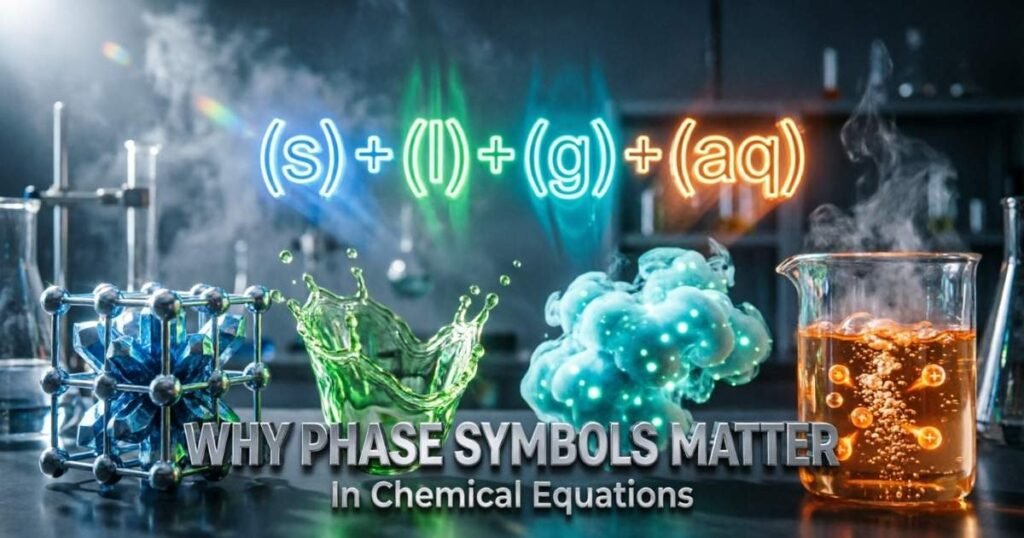
Phase make a chemical equation easier to understand at a glance. They show whether each substance is a solid, liquid, gas, or dissolved in water. Without these labels, you might miss important details about a reaction. They also help explain how substances behave and interact during a chemical reaction under specific conditions.
These symbols also matter when you write balanced equations or ionic equations. For example, a dissolved substance behaves differently from a solid precipitate. The labels can show when a gas forms or when a substance stays in solution. In chemistry, even a small symbol can change how you interpret the entire reaction.
Phase Symbols and Precipitation Reactions
A precipitation reaction happens when two solutions form an insoluble solid. Phase help you spot this change quickly. For example, mixing silver nitrate and sodium chloride produces solid silver chloride. The precipitate appears as AgCl(s), while dissolved substances carry the (aq) label. These small marks make the reaction easier to understand and interpret.
In chemistry, solubility rules help predict whether a precipitate will form. The phase then confirm the physical state of each substance. This is especially useful when writing complete ionic equations and net ionic equations. You can see which ions remain dissolved and which combine to create a solid.
- (aq): Shows substances dissolved in water.
- (s): Identifies the solid precipitate.
- Solubility rules: Help predict insoluble products.
- Precipitate: A solid formed from a solution.
- Ionic equations: Show which particles take part in the reaction.
Physical State Changes and Phase Symbols
Matter can change from one physical state to another when temperature or pressure changes. Phase show these changes clearly in chemical equations. For example, ice is written as H₂O(s), while melted water becomes H₂O(l). Heating can also produce steam, written as H₂O(g), showing that the same substance can exist in different states.
These changes don’t create a new substance. Melting, freezing, evaporation, condensation, and sublimation only change the physical state. Phase help you track each change easily. They also make chemistry equations more precise by showing exactly what form a substance takes before, during, or after a physical process.
- Melting: Solid changes into a liquid.
- Freezing: Liquid changes into a solid.
- Evaporation: Liquid changes into a gas.
- Condensation: Gas changes into a liquid.
- Sublimation: Solid changes directly into a gas.
Read More : Piteraq Meaning: Origin, Causes, Wind Speed & Greenland Weather
Phase Symbols in Balanced Equations
A balanced chemical equation shows the same number of each type of atom on both sides. Phase add another layer of detail by showing each substance’s physical state. For example, 2H₂(g) + O₂(g) → 2H₂O(l) shows hydrogen and oxygen as gases while water forms as a liquid.
When balancing an equation, don’t change the phase to balance atoms. Instead, adjust the coefficients before each chemical formula. The symbols remain attached to the substances they describe. This keeps the reaction equation accurate and helps you understand what happens to each substance during the chemical reaction.
Laboratory Use of Phase Symbols
In the laboratory, phase help scientists record reactions clearly. They show the physical state of substances and make observations easier to understand, compare, and document.
- Reaction records: Show each substance’s physical state.
- Experiment notes: Make laboratory observations clearer.
- Precipitate identification: Mark newly formed solids as (s).
- Gas production: Use (g) when a reaction releases gas.
- Solutions: Use (aq) for substances dissolved in water.
- Chemical equations: Add useful details to reaction descriptions.
- Result comparison: Help students and scientists compare experimental outcomes.
Phase Symbols in Thermodynamics
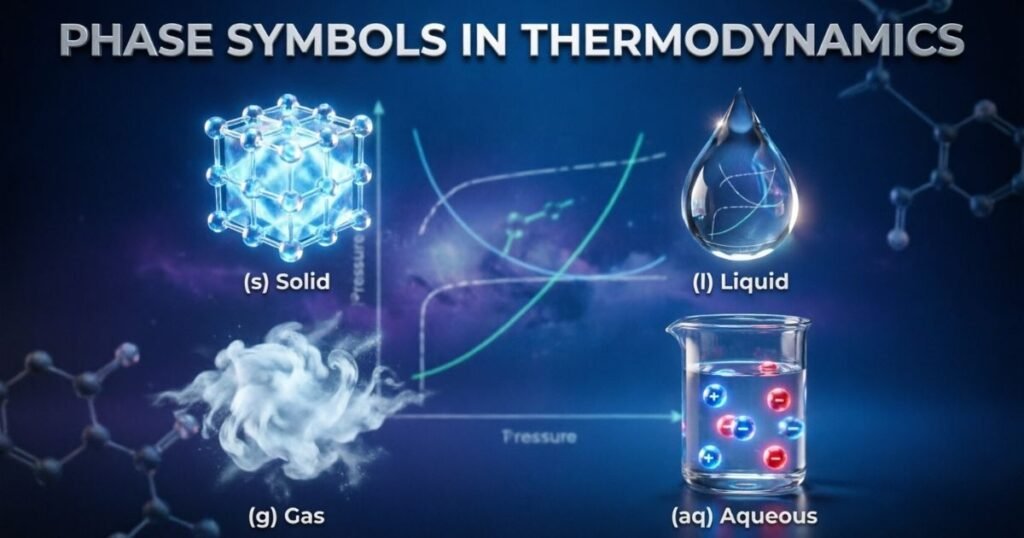
In thermodynamics, phase show the physical state of a substance during a process. They help you identify whether a material is solid, liquid, gas, or aqueous. This matters when studying heat, pressure, temperature, and energy changes. For example, H₂O(l) and H₂O(g) describe water in two different states with different energy levels.
These symbols also help explain phase changes and thermodynamic properties. Melting, boiling, freezing, and condensation involve energy transfers between particles. By adding state symbols to chemical equations, you can see which form of matter participates in each process. This makes thermodynamics notation easier to follow and helps connect equations with real physical changes.
State Symbols in Everyday Life
You see physical states around you every day, even when you don’t notice them. Water can exist as ice, liquid water, or steam. State symbols help chemistry describe these forms clearly. They show whether a substance is solid, liquid, gas, or dissolved in water, making everyday changes easier to connect with chemical equations.
For example, ice represents H₂O(s), drinking water can be H₂O(l), and water vapor is H₂O(g). Salt dissolved in water can be written as NaCl(aq). These simple labels help explain melting, boiling, evaporation, and dissolving. Once you recognize them, many common processes become easier to understand through chemistry.
Difference Between Phase Symbols and Chemical Symbols
Phase and chemical symbols may look similar in equations, but they provide different information. One shows a substance’s physical state, while the other identifies the element or compound.
| Feature | Phase Symbols | Chemical Symbols |
| Main purpose | Show the physical state of a substance | Identify an element or chemical substance |
| Common examples | (s), (l), (g), (aq) | H, O, Na, Cl |
| Meaning of (s) | Shows a solid state | Not applicable |
| Meaning of (l) | Shows a liquid state | Not applicable |
| Meaning of (g) | Shows a gaseous state | Not applicable |
| Meaning of (aq) | Shows a substance dissolved in water | Not applicable |
| Chemical identity | Doesn’t identify the substance itself | Identifies the element or forms part of a chemical formula |
| Position in equations | Usually appears after a chemical formula | Forms the chemical formula |
| Example | H₂O(l) shows liquid water | H₂O identifies water’s chemical composition |
| Role in chemistry | Explains physical state during a reaction | Shows what substances participate in the reaction |
How Temperature Changes Physical States
Temperature can change how particles move and affect a substance’s physical state. Heating may turn a solid into a liquid or a liquid into a gas. Cooling can cause freezing or condensation. Phase show these changes clearly. For example, water can appear as H₂O(s), H₂O(l), or H₂O(g), depending on its current state.
Pressure can also influence physical states, especially for gases. However, temperature often provides the easiest example to understand. When conditions change, the same chemical formula can receive a different phase. This helps you track melting, boiling, freezing, and condensation without confusing physical changes with new chemical substances.
Phase Symbols in Ionic Equations
Ionic equations show substances as ions when they dissolve in water. Phase help identify which particles remain dissolved and which form solids. For example, Ag⁺(aq) and Cl⁻(aq) can combine to produce AgCl(s). The aqueous label shows dissolved ions, while the solid label identifies the resulting precipitate.
These symbols are especially useful when writing net ionic equations. They help you separate spectator ions from particles that actually react. Without phase notation, it can be harder to understand what happens in solution. Clear symbols make ionic reactions easier to read, balance, and interpret correctly.
Gas Evolution Reactions
A gas evolution reaction produces a gaseous substance during a chemical reaction. The gas phase (g) makes this change easy to identify. For example, acids can react with carbonates and release carbon dioxide. The equation may show CO₂(g) as a reaction product, indicating that the gas leaves the solution.
Gas formation often creates visible bubbles during laboratory experiments. However, bubbling doesn’t always mean a chemical reaction has occurred. Boiling can also produce bubbles through a physical change. Phase help distinguish these situations and provide useful information about the substances involved in the reaction.
Read More; Delta Symbol Copy and Paste: Meaning, Alt Codes & Uses
Solubility and Phase Symbols
Solubility describes how well a substance dissolves in a particular solvent. Phase help show whether a substance remains dissolved or forms a solid. A dissolved compound receives the (aq) label, while an insoluble product may appear as (s). This distinction becomes important when predicting precipitation reactions and writing chemical equations.
Solubility rules can help you predict which products remain in solution. For example, mixing suitable aqueous solutions may produce an insoluble precipitate. Writing the correct phase makes that change clear. It also helps when creating complete ionic and net ionic equations for reactions in water.
Phase Symbols in Organic Chemistry
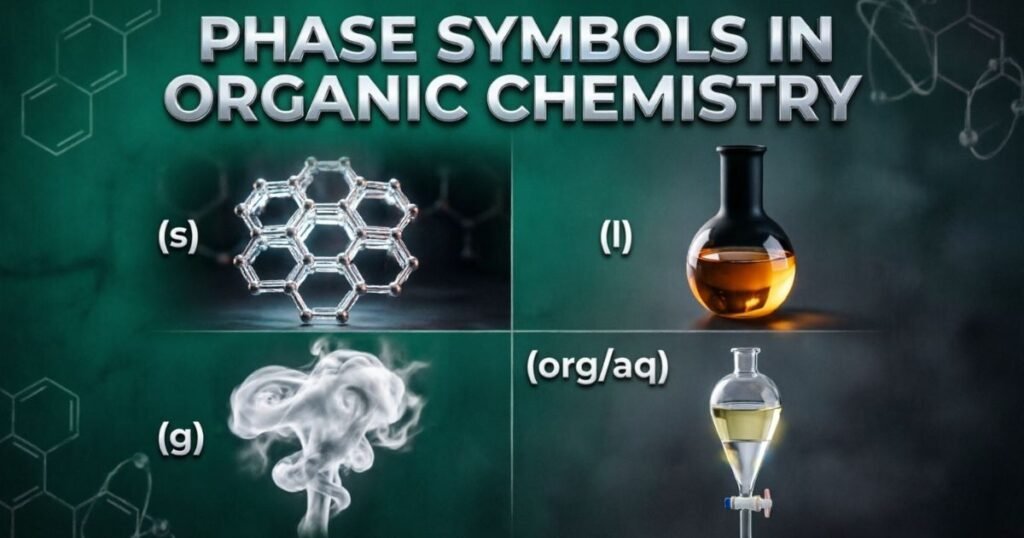
Organic chemistry uses phase to show the physical state of compounds in reactions. You may see organic substances labeled as solid, liquid, gas, or aqueous. For example, ethanol can appear as C₂H₅OH(l). These labels help explain how organic compounds behave during reactions and under different temperature or laboratory conditions.
Phase are also useful when studying purification methods. Distillation separates liquids based on differences in boiling points. Evaporation and condensation can change physical states without changing chemical identity. By including correct notation, organic chemistry equations become clearer and give readers a better picture of what happens during each reaction.
Educational Value of Phase Symbols
Phase give students a simple way to understand physical states in chemical equations. Instead of memorizing reactions alone, you can see whether substances are solids, liquids, gases, or dissolved in water. This makes abstract chemistry concepts more visual and easier to connect with classroom experiments and everyday examples.
They also strengthen important chemistry skills. Students learn to read chemical formulas, interpret balanced equations, and identify reaction products. Understanding symbols such as (s), (l), (g), and (aq) can make ionic equations and precipitation reactions much easier. These small details build confidence and improve accuracy when solving chemistry problems.
Tips for Writing Phase Symbols Correctly
Writing phase correctly makes chemical equations clearer and more accurate. A few simple habits can help you avoid common mistakes and identify each substance’s physical state.
- Use (s) for substances in the solid state.
- Use (l) for pure liquids.
- Use (g) for substances in gaseous form.
- Use (aq) for substances dissolved in water.
- Place symbols after formulas, such as H₂O(l).
- Don’t confuse (aq) with (l) because aqueous means dissolved in water.
- Check conditions before assigning a physical state.
Frequent Errors Students Make
Students often confuse phase or place them incorrectly in equations. Learning these common mistakes can make chemical reactions easier to read and write.
- Using (l) instead of (aq) for dissolved substances.
- Forgetting phase in reaction equations.
- Changing symbols while balancing an equation.
- Writing symbols before formulas instead of after them.
- Confusing chemical symbols with state symbols.
- Assuming every water-based substance is (l).
- Ignoring temperature and pressure when physical states change.
Digital Chemistry Software and Phase Symbols
Chemistry software makes chemical equations easier to create, edit, and understand. Many digital tools let you add state symbols such as (s), (l), (g), and (aq) to formulas. This helps students and researchers show the physical state of substances clearly while building reaction equations.
Some programs can also check equations and highlight possible errors. For example, they may help identify missing state symbols or incorrect reaction products. Digital tools are useful for learning, but you should still understand what each symbol means. Software can assist you, but chemistry knowledge guides the correct choice.
Historical Background of Phase
Chemical equations weren’t always as clear as they are today. Early chemists used different ways to describe substances and reactions. As chemistry developed, standardized notation became important. Symbols for physical states gradually became useful for showing whether a substance was solid, liquid, or gaseous during a reaction.
Today, phase notation is a familiar part of chemistry education and scientific writing. Symbols such as (s), (l), (g), and (aq) make equations easier to understand. They give readers quick information about substances and help explain reactions, solutions, and physical changes without adding long descriptions.
- (s): Solid state
- (l): Liquid state
- (g): Gaseous state
- (aq): Dissolved in water
- Modern use: Common in equations and laboratory work.
Phase in Physics
In physics, phase can describe the physical state of matter during different processes. They help show whether a material is solid, liquid, or gas. This becomes useful when studying changes caused by temperature and pressure. For example, ice, water, and steam represent different physical states of the same substance.
Physics also examines phase changes such as melting, freezing, evaporation, and condensation. These processes involve changes in particle movement and energy. While chemistry often uses symbols like (s), (l), and (g), physics focuses more on the energy and conditions behind each state change.
Future Role of Phase Symbols
Phase will continue to make chemical equations clear and useful. Digital chemistry tools can display physical states alongside formulas. This helps students, researchers, and laboratory workers understand reactions faster. As chemistry education becomes more interactive, simple notation like (s), (l), (g), and (aq) will remain an important part of scientific communication.
Future chemistry software may connect phase with temperature, pressure, and solubility data. This could make reaction simulations easier to understand. Automated tools may also check equations for incorrect state symbols. Still, students will need to understand what each symbol means rather than relying completely on software.
- Digital learning: Makes chemical states easier to visualize.
- Reaction simulations: Shows physical changes during reactions.
- Smart software: Can identify incorrect phase notation.
- Laboratory technology: Supports clearer experimental records.
- Future education: Keeps chemistry concepts simple and understandable.
Frequently Asked Questions
What Is a Phase Symbol?
A Phase shows a substance’s physical state in a chemical equation. Common examples include (s) for solid, (l) for liquid, and (g) for gas.
How to Type a Phase?
You can type a Phase by adding (s), (l), (g), or (aq) after a chemical formula. No special keyboard shortcut is normally needed.
What Does φ Mean in Math?
The symbol φ is a Greek letter called phi. It can represent angles, the golden ratio, or other values depending on the mathematical context.
What Is an Icon for Phase?
There isn’t one universal icon for phase. In chemistry, a Phase uses labels such as (s), (l), (g), and (aq) to show states.
What Does (s) Mean in Chemistry?
The Phase (s) means a substance exists as a solid. It commonly appears after formulas for metals, crystals, and solid compounds in chemical equations.
What Does (l) Mean in Chemistry?
The Phase Symbol (l) shows that a substance is in the liquid state. Water, ethanol, and other pure liquids may use this notation.
What Does (g) Mean in Chemistry?
The Phase Symbol (g) indicates that a substance exists as a gas. It helps identify gases formed or used during chemical reactions.
What Does (aq) Mean in Chemistry?
The Phase Symbol (aq) means a substance is dissolved in water. It’s commonly used for soluble compounds and ions in aqueous solutions.
Why Are Phase Important?
A Phase gives quick information about a substance’s physical state. This makes chemical equations clearer and helps explain reactions, precipitation, and state changes.
Are Phase Used in Balanced Equations?
Yes, Phase can appear in balanced equations. They show each substance’s physical state without affecting the numerical balancing of atoms in the equation.
Conclusion
Understanding the Phase Symbol makes chemical equations much easier to read. These small labels show whether a substance is solid, liquid, gas, or dissolved in water. The main phase chemistry uses are (s), (l), (g), and (aq). Each one gives useful information about a substance’s physical state. The symbol for phase also helps explain reactions, precipitation, solubility, and physical changes.
The Phase Symbol is simple but important in chemistry. You’ll see these labels in balanced equations, ionic equations, laboratory work, and reaction studies. Knowing each state symbol helps you understand what happens during a chemical reaction. It can also prevent common mistakes when reading formulas. Once you understand these labels, chemical equations become less confusing. With a little practice, you can use phase chemistry correctly and confidently.