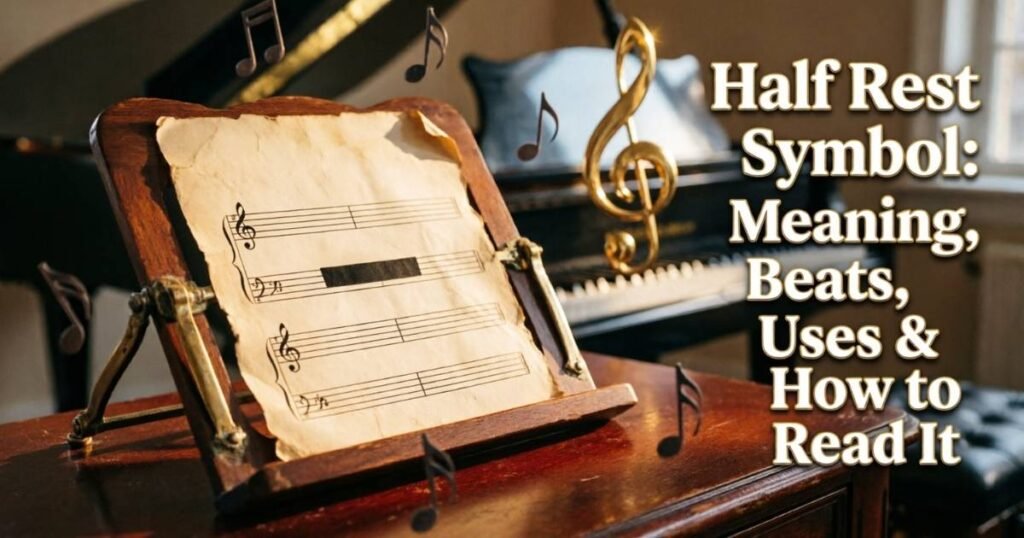

Reading music can feel tricky when a strange mark appears on the staff and you’re unsure what to do. The Half Rest Symbol tells you to stay silent for two beats in common time. At first, it may look confusing, but its purpose is simple. It creates a short pause while keeping the music moving at the correct rhythm.
This guide will help you understand the half note rest and how it works in different musical situations. You’ll learn the meaning of a half rest symbol, its beat count, and how to recognize the half note rest symbol quickly. We’ll also cover time signatures, piano music, drumming, singing, practice tips, and common beginner mistakes.
Appearance of the Half Rest Symbol
The half rest looks like a small, solid rectangle placed above the middle line of the music staff. It resembles a tiny hat resting on the line. This simple shape helps musicians recognize it quickly. Unlike notes, it produces no sound. Instead, it marks a specific period of silence within written music and keeps the rhythm organized.
When you see the half rest symbol in music, you know the performer should remain silent for two beats. Its position helps distinguish it from the whole rest symbol, which hangs below a staff line. Learning this visual difference is useful for beginners. With regular practice, you’ll spot both rests quickly while reading sheet music and counting rhythm.
Beat Count of a Half Rest
A half rest normally lasts for two beats in 4/4 time. It creates silence without stopping the rhythm. You can think of it as two empty counts while other instruments continue playing. For example, count 1, 2 during the rest. Keeping the pulse steady helps you stay ready for the next note or musical phrase.
The beat value can change with the time signature, so always check the meter first. A half rest has the same basic duration as a half note. Remember these points:
- Beat value: Two beats in 4/4 time.
- Sound: No sound is played during the rest.
- Counting: Count steadily through both silent beats.
- Rhythm: The rest keeps your timing organized.
- Comparison: It matches the duration of a half note.
Half Rest in Different Time Signatures
A half rest keeps its basic two-beat value in simple meters, but its role can change with the time signature and surrounding rhythm.
- 4/4 time: A half rest lasts for two beats.
- 3/4 time: It lasts for two of the three beats.
- 2/4 time: It can fill the entire measure.
- 6/8 time: Its use depends on the rhythmic grouping.
- 2/2 time: It normally lasts for one half-note beat.
- 3/2 time: It covers two beats within the measure.
- Changing meters: Always check the time signature before counting.
Read More : Freedom Symbol: Meaning, History, Types, and Symbols of Liberty
Difference Between Half Rest and Whole Rest
The half rest and whole rest both create silence, but they differ in beat value and placement. Knowing these differences helps you read music notation accurately.
| Feature | Half Rest | Whole Rest |
| Beat value | Usually 2 beats | Usually 4 beats |
| 4/4 time | Fills half the measure | Fills the entire measure |
| Appearance | Sits above a staff line | Hangs below a staff line |
| Related note | Matches a half note | Matches a whole note |
| Silence | Creates shorter silence | Creates longer silence |
| Common use | Covers two beats | Often covers a full measure |
| Counting | Count 2 beats | Count 4 beats in 4/4 |
| Staff position | Above the middle staff line | Below the middle staff line |
| Rhythm role | Creates a two-beat pause | Creates a four-beat pause |
| Time signatures | Its value follows the meter | Its use can represent a full measure depending on context |
Why Rests Matter in Music
Music isn’t only about playing notes. Silence gives a piece space, shape, and emotion. Musical rests help performers follow the rhythm and know when to stop playing. They also separate phrases and create contrast. Without rests, music could feel crowded and rushed. Even a short pause can make the next note sound more powerful.
Rests help you understand the structure of written music. They keep every performer synchronized and make rhythm easier to follow.
- Timing: Keeps the beat steady.
- Phrasing: Separates musical ideas.
- Emotion: Creates tension or calm.
- Clarity: Makes sheet music easier to read.
- Coordination: Helps performers play together.
Half Rest Symbol in Piano Music

Piano players use rests just as often as notes. A half rest tells you to remain silent for two beats in common time. You may see it in the right or left hand, depending on the music. Counting those silent beats helps you keep steady rhythm and stay synchronized with the other musical parts.
When reading piano music, watch both staves carefully. A rest in one hand doesn’t always mean the other hand stops.
- Right hand: May pause while the left hand plays.
- Left hand: Can rest while the melody continues.
- Both hands: May rest together.
- Counting: Keep the pulse during silence.
- Phrasing: Rests can create space between musical ideas.
Half Rest Symbol in Drumming
Drummers use rests to create clear spaces in a rhythm. A half rest tells the drummer to stay silent for two beats when its value applies. The hands or feet remain still during that time. However, the drummer must keep counting internally. This helps maintain timing and prepares them for the next hit.
In drum notation, rests can appear between different rhythmic patterns. Their placement tells you when not to play.
- Silence: No drum hit occurs during the rest.
- Counting: Keep counting the beats internally.
- Timing: Follow the song’s steady pulse.
- Coordination: Other instruments may continue playing.
- Rhythm: Rests help create space and musical contrast.
Half Rest Symbol in Vocal Music

Singers use rests to know when to stop singing and when to begin again. A half rest creates two beats of silence in common time. During this pause, the singer should keep counting internally. This helps maintain the melody, rhythm, and timing without adding unwanted sounds to the musical phrase.
In vocal music, rests also give singers time to breathe or prepare for the next phrase.
- Silence: The singer remains quiet.
- Counting: Keep the beat mentally.
- Breathing: Use pauses when appropriate.
- Timing: Enter on the correct beat.
- Phrasing: Rests create natural musical space.
History of Musical Rest Symbols
Musical rests have been used for many centuries to show silence in written music. Early notation systems used various marks to indicate pauses and periods without sound. Over time, musicians developed clearer ways to record rhythm. These changes made it easier for singers and instrumentalists to understand when to play, pause, and continue together.
During the Renaissance and Baroque periods, composers increasingly used recognizable rest signs in scores. The growth of printed music helped spread more consistent notation across Europe. As music theory developed, different symbols gained specific rhythmic values. This allowed performers to read silence as carefully as they read notes and maintain accurate timing throughout musical pieces.
Today, rest symbols are a basic part of modern music notation. Common examples include whole, half, quarter, eighth, and sixteenth rests. Each mark represents a different length of silence. These symbols help performers follow rhythm, understand musical phrases, and stay together during performances. Without clear rests, reading complex sheet music would become much harder for musicians.
Tips for Reading Half Rests Correctly
Reading rests becomes easier when you focus on their shape, position, beat value, and time signature. Count silently and keep the pulse steady throughout every pause.
- Know the shape: Recognize the mark quickly on the staff.
- Check placement: A half rest sits above the middle staff line.
- Count two beats: In 4/4 time, count one and two.
- Watch the meter: Check the time signature before counting.
- Keep tempo: Continue feeling the pulse during silence.
- Follow both hands: In piano music, each hand may have different rests.
- Practice slowly: Start with simple rhythms before reading harder passages.
Common Beginner Mistakes
Rests can look simple, but small reading mistakes can change the whole rhythm. Beginners often focus so much on the notes that they forget silence has a value too. Learning where rests appear and how long they last will help you play with better timing and confidence.
Confusing Whole and Half Rests
One common mistake is mixing up the whole rest and half rest. A whole rest usually hangs below the middle staff line, while a half rest sits above it. Their beat values also differ. In 4/4 time, a whole rest represents four beats, while a half rest represents two. Remembering both shape and position makes identification easier.
Skipping Silent Beats
Some beginners stop counting when they see a rest. That can cause them to enter too early. A rest still takes up musical time, even though you don’t play or sing. For example, count one and two during a two-beat rest. Think of silence as part of the rhythm rather than an empty space that you can ignore.
Losing Tempo
It’s easy to rush through silence because nothing seems to happen. However, the beat must continue inside your head. Use a steady count or metronome while practicing. If a half rest lasts two beats, give it the full two beats. Keeping the pulse steady helps you return at the right moment and stay synchronized with other performers.
Ignoring Time Signatures
The time signature tells you how beats are organized within each measure. Ignoring it can lead to incorrect rhythm counting. A rest may have a familiar value, but its role can change depending on the meter. Before playing, check the time signature. Then count the beats carefully so every note and rest fits naturally within the measure.
Takeaway: Most rest-reading mistakes come from rushing or miscounting. Focus on the symbol, count every silent beat, and watch the time signature. With regular practice, reading rests becomes much more natural.
Read More : Majin Symbol: Meaning, Origin, Power, Vegeta & Anime Symbolism
Memory Tricks for Students
Learning musical rest symbols becomes easier when you connect each shape with a simple visual idea. These memory tricks can help students remember the half rest, its position, and its two-beat value without relying on guesswork.
The interpretation may vary depending on the situation:
- Think of a hat: The half rest sits above the staff line, like a small hat.
- Remember two beats: Connect the half rest with the number two.
- Use a counting phrase: Say one, two silently while holding the rest.
- Compare shapes: The whole rest hangs down, while the half rest sits up.
- Practice with sheet music: Circle rests during rhythm reading to recognize them faster.
Practice Exercise for Half Rests
Practice helps you recognize a half rest quickly and keep accurate rhythm. Simple exercises can improve your counting skills and make musical rest symbols easier to read in sheet music.
The interpretation may vary depending on the situation:
- Clap and count: Clap on played notes while counting silent beats aloud.
- Use a metronome: Set a slow tempo and count two steady beats during each rest.
- Read short measures: Practice simple rhythms containing notes and half rests.
- Switch instruments: Try the exercise with piano, vocals, or drum notation.
- Check your timing: Record yourself and listen for early or late entrances.
Regular practice builds confidence. If you rush the silence, slow down and count each beat carefully.
Digital Music Software and Half Rests
Digital music software makes learning and writing rests much easier. Programs such as notation editors let you insert, move, and edit a half rest with a few clicks. You can also hear the surrounding rhythm and check whether the silence fits the measure. This helps students understand music notation while practicing accurate rhythm and timing.
Many digital tools also adjust rests automatically when you change notes or time signatures. You can zoom in to inspect symbols and correct mistakes quickly. These features are useful for beginners, composers, and teachers. Still, understanding the written symbol remains important, even when software handles much of the formatting.
Half Rest Symbol in Music Education
Music teachers introduce rests early because silence is part of rhythm. The half rest helps students learn to count two silent beats while keeping a steady pulse. Teachers often use clapping, counting, and simple sheet music exercises. These activities make music notation easier to understand and help beginners connect symbols with actual timing.
Students also practice identifying the half rest on the staff. They compare it with whole and quarter rests to understand different beat values. Regular exercises improve rhythm reading and confidence. Over time, students learn that silence isn’t an empty space. It’s an important part of musical expression and structure.
Fun Facts About the Half Rest
The half rest may look simple, but it plays an important role in music. Its shape, timing, and placement make rhythm easier to understand and perform.
- It usually represents two beats in 4/4 time.
- It looks like a small hat above a staff line.
- It creates silence without stopping the musical pulse.
- Its value matches a half note.
- Singers, pianists, and drummers all use rests.
- Its placement helps distinguish it from a whole rest.
- Learning rests can improve rhythm reading and timing.
Frequently AskedQuestions
What does a half rest symbol mean?
A Half Rest Symbol shows silence for two beats in common time. It keeps the rhythm moving while the performer remains completely silent.
How many beats does a half rest receive?
A Half Rest Symbol usually receives two beats in 4/4 time. You should count both silent beats before playing or singing again.
Do singers use half rests?
Yes, singers use a Half Rest Symbol to mark silence between vocal phrases. They continue counting internally to enter correctly on time.
Is a half rest difficult to learn?
A Half Rest Symbol is easy to learn with practice. Remember its shape, position, and two-beat value when reading music notation.
Can music exist without rests?
Music can contain fewer rests, but silence remains important. A Half Rest Symbol creates space, controls rhythm, and helps shape musical phrases.
Where does a half rest sit on the staff?
A Half Rest Symbol normally sits above the middle staff line. Its position helps distinguish it from the whole rest in written music.
What is the difference between a half rest and whole rest?
A Half Rest Symbol usually represents two beats, while a whole rest represents four beats in 4/4 time. Their staff positions also differ.
How do you count a half rest?
Count the Half Rest Symbol steadily as one and two. Keep the pulse moving internally so you enter accurately when the silence ends.
What does a half rest look like?
A Half Rest Symbol looks like a small rectangle or hat resting above the middle staff line. Its appearance makes identification easier during rhythm reading.
Why is the half rest important in music?
The Half Rest Symbol gives performers controlled silence while maintaining rhythm. It creates space, separates phrases, and helps musicians coordinate their timing.
Conclusion
The Half Rest Symbol is an important part of music notation. It usually shows two beats of silence in 4/4 time. Learning this mark helps you keep a steady rhythm and enter at the right moment. The half note rest has the same basic duration as a half note. Understanding the half rest also makes sheet music easier to read.
The half note rest symbol appears in piano, vocal, and drum music. Its position on the staff helps you identify it quickly. Remember its shape and two-beat value while practicing. Once you understand this rest, counting silent beats becomes easier. Regular practice can improve your timing, rhythm, and confidence when reading music.